
Most AV company decisions happen too fast. A date gets locked, a venue gets booked, and someone is searching “AV company San Antonio” ten days before the event. Whatever comes back first gets the call. San Antonio runs enough serious events, conferences at the Henry B. González Convention Center, galas at the JW Marriott, outdoor festivals drawing tens of thousands into Bexar County, that the market here has real range. The difference between tiers is not always obvious in a quote. It tends to show up during load-in, or midway through the opening session, when the window to fix something is already closing.
The criteria most event planners use to evaluate AV companies are usually too narrow. Price. Availability. A quick search. Those filters will get you a company. They will not necessarily get you the right one.
What you need is: A local crew with real venue knowledge.
San Antonio’s event spaces are not interchangeable. Loading into the Henry B. González Convention Center operates differently than loading into a La Cantera ballroom. A crew that has done it before moves faster, asks better questions, and catches problems before they surface in front of an audience. A crew that has not done it is learning on your event.

San Antonio’s event calendar is substantial. The combination of hotel infrastructure, convention capacity, and the city’s position as one of Texas’s largest markets means professional events run year-round across a wide range of formats. These categories share a common requirement: they need AVL production, not rental equipment.
Conferences in San Antonio scale from 50-person executive offsites to multi-day productions with 5,000 attendees running across venues including the Henry B. González Convention Center, the JW Marriott San Antonio, and the Hyatt Regency San Antonio.
At that scale, AVL requirements stack quickly. LED video walls for the general session. Confidence monitors at the lectern. Line array audio tuned to the room. Wireless microphone packages for keynote speakers and panel discussions. Breakout rooms running parallel sessions that need to feed into a central production workflow. Coordinating that system across a multi-room venue requires a crew. A delivery truck will not get you there.
Galas are atmospheric events, and atmosphere is almost entirely a production question. Uplighting, intelligent lighting, stage design, and video playback for award presentations shape how the room feels from the moment guests walk in.
Nonprofit fundraisers add timing pressure to an already demanding production. A live auction with video tributes and moment-specific lighting cues requires an operator who has run that kind of show before. The margin for visible error is narrow. When 300 donors are in a room that took a year to fill, the production quality carries weight well beyond the technical.
Product launches are scripted events, and scripted events surface production problems fast. LED walls, pre-produced video playback, live camera feeds, and coordinated audio all run on cue. When they do, the launch feels considered. When they do not, the audience notices before the presenter does.
Executive audiences are a specific challenge. They are experienced enough to recognize when production is off, and they carry that impression out of the room. A product launch at a San Antonio hotel with 200 buyers in attendance is a brand communication event. The production is part of the message.
Outdoor events carry a different class of production requirements. Line array audio designed for open-air coverage. Large-format video displays visible in full daylight. Power load coordination across a site that may have no permanent electrical infrastructure. Weather contingency planning built into the run-of-show. All of it resolved before a single attendee arrives.
Texas AVL produces large-scale outdoor events in San Antonio with line array systems capable of covering audiences in the tens of thousands. For example, we provided professional audio-visual production for the Rise Against tour, delivering high-impact lighting and sound design for rock concerts across Texas with crowds in the tens of thousands. Outdoor production also has a longer setup window and a much narrower recovery margin. A crew encountering South Texas outdoor production variables for the first time is solving those problems at your expense.
Trade show production at venues like the Henry B. González Convention Center runs at scale and in close proximity. Exhibitor display screens, presentation systems, and audio in a high-ambient-noise hall all need to be managed without bleeding into adjacent booths.
The technical challenge is separation. Sound that carries two booths over creates a problem for every exhibitor nearby. An AVL company with trade show experience knows how to design systems that hold attention without creating interference, and how to set up and strike within the show schedule.
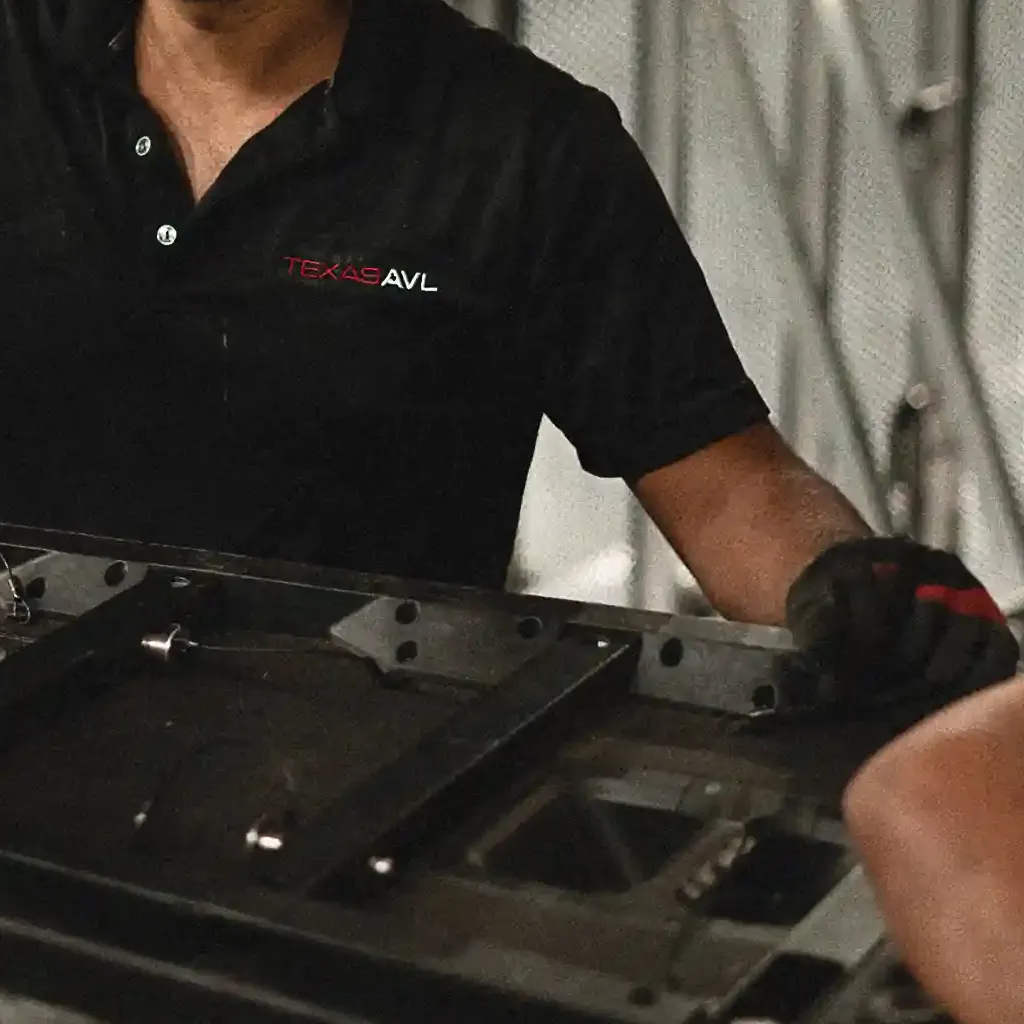
Subcontracting is common in the AV industry and is not automatically a disqualifier. But it adds an accountability layer that matters when something goes wrong. If a subcontracted operator underperforms on event day, the production company may not have the leverage to resolve it quickly. Texas AVL operates with its own production crew. The people on-site are the people who own the outcome.
This question is your secret weapon. Here’s why: venues have personalities. The Henry B. González Convention Center has different rigging points than the JW Marriott San Antonio. Power locations shift. Load-in access can be a nightmare if you don’t know the shortcuts. Room acoustics vary wildly. And every venue has in-house coordinators with their own expectations and working styles.
When an AVL company has already produced events at your venue, they’ve already solved these puzzles, without charging you for their learning curve. First-time crews encounter these variables at your expense: delayed load-ins, awkward sound checks, power mishaps, and coordinator friction. A company with venue experience walks in knowing where the nuts and bolts are, how the room sings, and which coordinator to find at 6 AM.
A company’s minimum tells you where they sit in the market. No minimum often means they take any job regardless of fit, which affects crew quality and production attention. Texas AVL operates with a minimum engagement starting at $600, placing the company in the professional production tier rather than the commodity rental segment.
Some AV companies specialize in one or two disciplines and subcontract the third. Texas AVL provides all three under one production umbrella: one point of contact, one production design, one crew accountable for the full show.
Every professional AVL company should answer this without hesitation. The answer you want involves redundant equipment staged on-site. The answer that should concern you references a call to the warehouse.
Texas AVL covers San Antonio, Austin, and Laredo. For clients running multi-city programs across South and Central Texas, that regional coverage means one vendor relationship rather than three.
Ask for specifics. A professional company can tell you exactly what they operate for a 200-person dinner, a 1,000-person conference session, and a large-scale outdoor production. If the answer is vague, that is the answer.
San Antonio is home to our primary operations. From Riverwalk productions to major conventions at the Henry B. Gonzalez Convention Center. Our San Antonio team is available for local events and productions across the greater SA metro.
Texas AVL supports Austin’s growing event and corporate market with the same level of equipment quality and professional execution that defines every production we touch. From tech conferences to live music events.
Our Laredo location serves the binational market, supporting events on both sides of the border with experienced crew and professional-grade AV equipment ready to deploy on short notice.
Tell us about your project and we’ll put together the right AV solution for your event, budget, and timeline.
